Monday, March 2, 2020

Your Experience Can Lie to You


Malcolm Gladwell is one of the authors (Outliers, Blink, The Tipping Point) and podcasters (Revisionist History) that I really pay attention to. 
He has a unique way of looking at things from all angles. 
One thing that Malcolm Gladwell said in his book, Outliers, has really stuck with me.
He is credited with saying that you need 10,000 hours to become an expert at something. 
Here’s his quote:
“To become a chess grandmaster also seems to take about ten years. (Only the legendary Bobby Fisher got to that elite level in less than that amount of time: it took him nine years.) And what’s ten years? Well, it’s roughly how long it takes to put in ten thousand hours of hard practice. Ten thousand hours is the magic number of greatness.”
That doesn’t mean that 10,000 hours of practice will make you an expert, but it is a prerequisite to becoming an expert.
And this makes sense.
You can be good at what you do, but without years of practice, you won’t become an expert.
And while experience matters, unfortunately, our experience can also lie.
I’m a big believer in practice makes perfect.  But if you are practicing bad habits, they will eventually get set in stone and make you think you have perfected something.
For example:
In parenting – “Well, I raised three kids and none of them turned out to be ax murderers.” is a favorite statement by grandparents when giving out unsolicited advice to parents. 
They are saying that they’re advice should be used, because they are experts. 
And they think they are experts because you aren’t an ax murderer.  Seriously.
While they get credit for not raising ax murderers (not sure why that was the benchmark for Baby Boomers), there are 7+ billion people on planet Earth. 
The stork brought exactly zero of them. 
But you would have to assume that there aren’t 7+ billion people that could be considered experts, correct? 
That’s not to say that a lot of grandparents aren’t experts, but they can’t all be experts, simply because they were parents for a long time.
In your job – Have you ever had a boss that was in over their head?  It’s called the Peter Principle.
The Peter Principle is an observation that the tendency in most organizational hierarchies, such as that of a corporation, is for every employee to rise in the hierarchy through promotion until they reach a level of respective incompetence.
Simply having several years of experience in your job doesn’t mean you are necessarily great at your job. 
You may just be good enough not to get fired.  You know, like a C+ student.
In small your business – “We have 20 years of experience” is often a marketing strategy that is much overused. 
Yes, I want my insurance agent to have a lot of experience in reading policies, but I would prefer someone that is experienced AND good. 
It is quite possible that our experience is just good enough to keep you in the same place for 20+ years.
So how do you know if your experience is lying to you?
  • Are your sales the same now as they were 5 years ago?
  • Are you doing the exact same tasks that should’ve been already outsourced or do you have the same exact number of employees from 5 years ago?
  • Are you doing the exact same thing in all areas of your business because “that’s the way we’ve always done it”?

If the answer is yes to any of those questions, your old experience may need to be tossed for some new experiences out of your comfort zone.
10,000 hours is only good if it leads to expertise.  It’s not good if it leads to complacency.
Oh, and the ax murderer parenting comment doesn’t apply to my parents or my in-laws…much😁.  

Tuesday, February 4, 2020

This Bad Habit Might Be a Good Thing


One of the worst habits we have in my household (well, I have) is comparing what we have to someone else has.

And there’s always someone with something nicerJ.

  •          We got a 55 inch 4k TV, but…my sister-in-law got a 75 inch TV that has such a clear picture I thought that Derrick Henry was in their living room.
  •          We went to the beach in the fall, but…another family we know owns their own beach house.  And a lake house.  And a cabin in the mountains.  And blah, blah, blah.


We are constantly comparing ourselves with others to measure how well we are doing. 

This is not a very healthy thing to do on an individual basis.

But…

This could be a good thing in your business!

No, you shouldn’t stress out if a competitor has a new product or just moved to a bigger location.

However, you should be comparing your Income Statement to the industry average.

Why?
“What gets measured gets done!”

For example:
  •        If you are a restaurant owner what is your cost of goods sold (COGS), compared to other restaurants? The average is 37%.
  •        If you are a landscaper, do you know what your payroll costs are compared to other landscapers? The average is 22.50% and revenue per employee is $72,347.
  •        If you are a department store, do you know what your rent is compared to other department stores? The average is 5.36%
  •        If you are a real estate broker what should you be spending on marketing compared to other brokers? The average is 3.52%


Small business owners do a good job of comparing their current business to what they did last year, however, they need to know how their Income Statement compares to the industry as a whole.

Common measurements are your costs-of-goods-sold (COGS), net profit margin, current ratio, percentage of expenses versus income, etc. 

Comparing against other businesses in your industry is a more accurate way to determine how well you are doing and what you could improve upon.

Below are some great places to find these types of benchmarks for your industry:
  • Your CPA
  •   www.bizstats.com
  • Your trade association for your industry
  • You could always contact your friendly TSBDC for this type of comparison, charles.alexander@volstate.edu 


p.s.
And if you just got a new smoker, I don’t want to hear about it.  Mine is just fineL.

Friday, November 1, 2019

How You Can be UNIQUE and Immediately STAND OUT

A few years ago, my wife (Sarah) and I visited my daughter Ava’s elementary school to do something called “Parent Share”. 

“Parent Share” is when grownups bore little kids with what they do for a living.

Since Sarah and I are entrepreneurial, we decided to help 140 second graders start a business.
Should be easy, right:)?

We took on about 40 kids at a time, putting 4-5 kids per business.

We had them pick a business, name it, decide what they were going to sell, price items, and even do an organizational chart.

But most importantly, we had them describe why their business was different and why customers would buy from them.

We got some shocking results!

And by shocking, I mean, we had dozens of 7 and 8 year-olds GET IT!

We had a photography business that sold “very expensive photos, but they are all 3D and the customer gets to edit them.” And there was a candy store that “had the most sugar in their candy, than anyone else!”

Out of 35 business, there were only a couple that were the best or cheapest. 

Oh, and there were ZERO business with X number of years of experience, great customer service, or had some complicated-sounding certifications.

Why?

Kids know you can’t be the same as everyone else and expect to STAND OUT among everyone else

Odds are, you are unique, and there is a good reason for someone to buy from you instead of your competitor.
·                     If you are truly the expert, display it.
·                     If you really serve a special market, make sure everyone knows about it.
·                     If you are the most convenient, fastest, or most accurate, hang your hat on it.

And if that seems too difficult, I know a few kids you can hireJ.

Monday, September 30, 2019

This is How to Get 28 Hours in A Day


Good lord…this is actually a little embarrassing and I’m just observing, not participating.

Well, not participating at this particular moment, but honestly, I’m just as bad as everyone else.

Or at least I was, but I’m really working hard not to be.

I was sitting in the doctor’s waiting room for my annual physical with at least 15 other people (Baby Boomers and Gen Xers).

Even though there was a variety of ages, races, men, women, singles, and grandparents, there was one common thread among them all.

Every one of them had their face buried in their phones:(.

Millennials catch all the misery from the rest of us about their phone use, but we are just as bad, if not worse.

Yes, these fine folks could have been highly productive answering a very important work email that will make the company millions, but more likely, they were scrolling through Facebook, mindlessly looking at everyone else’s carefully curated life or playing Candy Crush.

And before you think this is just some rant about how in the good ole days people would actually interact with each other, I want you to think about this question. 

How much time do you spend on your phone?

(And yes, I get the irony of you possibly being on your phone to read this, but humor me anyway.)

1 hour?  2 hours?  All day?

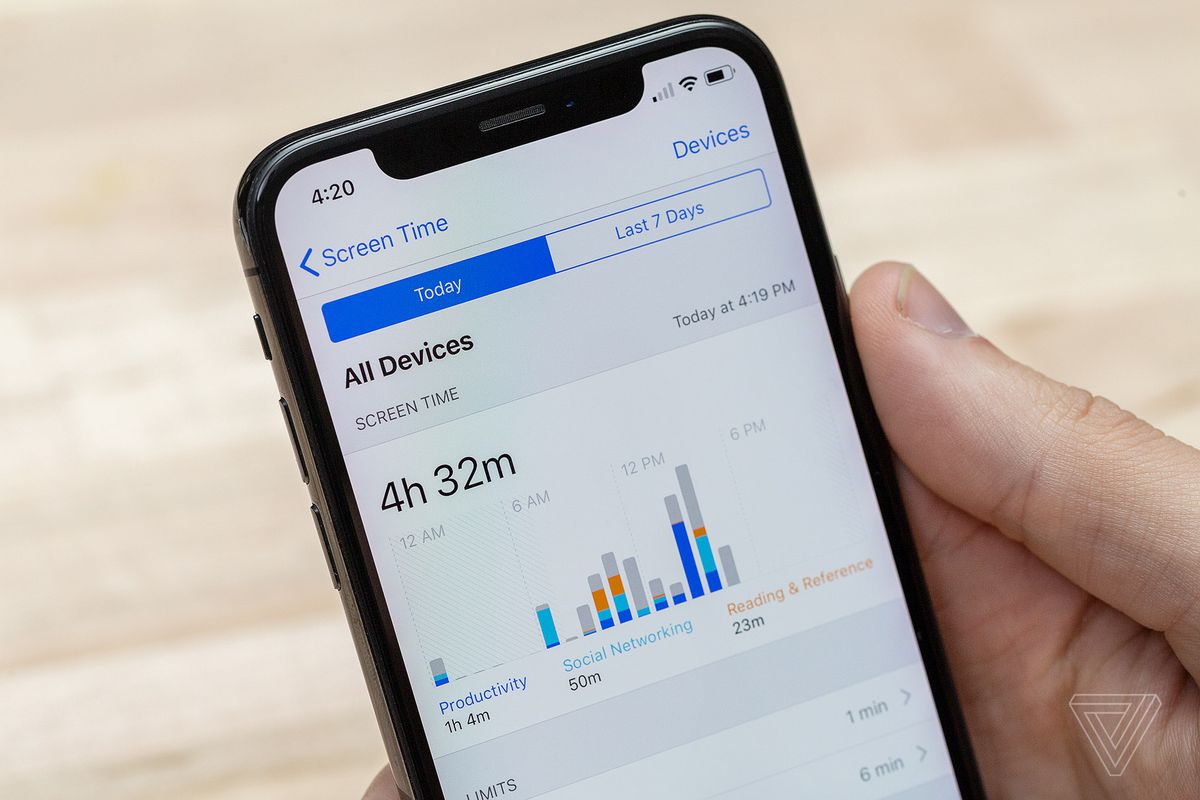
The average American spends 4 hours a day on their phone!

If you are an iPhone user, let’s check your answer.


Go to Settings -> Screen Time -> Tap on the time

And to see how your week has gone tap on “7 Days”

Also how many pickups do you have?  

How many times did you receive a notification?

Let’s give that some context.

If you sleep 8 hours a night, that means you are spending 25% of your waking hours staring at your phone.  

That’s literally 3 waking months a year with your face 1 foot from a 5-inch screen.

That’s nuts!

Now I know there are a ton of excus…I mean good reasons that you need to be on your phone that amount of time, i.e. work, checking out the grandkids pics, shopping for essentials, staying on top of the news, etc.

But do you get 4 hours worth of goodness out of it?  

Most of the really important things take less than an hour.

So how about the advantages it brings you?

It’s entertainment and it’s not hurting anyone, right?

The fact is there a lot of studies that show that more time on your phone increases anxiety and decreases mental focus.

I’ve recently made an effort to decrease my phone time to less than an hour a day and I’m down to about an hour a day.  

I suddenly have more time to concentrate on “real” work and feel less anxious about unimportant emergencies.

Could you give up your phone for a day?  How about a half-day?  Just try one hour.

Yes, this might mean some short term pain for long term gain, but that’s where most of the good things in life come from.

You can always rationalize how you might miss some big event or lose a customer forever, but way more likely, you will get much more gain than you lose from this little experiment.

Friday, August 30, 2019

Do This In Your Business Or Suffer The Consequences


This past fall we bought a new house in Gallatin.


This is our fourth house (and last) we have bought since we’ve been married, and all have been fixer-uppers because raising three kids and working full-time just wasn’t stressful enough.

This house was the epitome of a needle in a haystack.  

The market was hot, the house was in the best location, and it had great “bones”.  

And if you don’t know, great “bones” means it’s a good house, but’s also a hot mess right now.

After about a month straight of rehabbing, the house was ready to move in.  

All it needed was carpet, paint, refinish the floors, windows, appliances, countertops, tons of new fixtures, woodwork, gutters, etc.  

You know, basically everything.

We still managed to stay on budget and walk in with enough equity to make it worthwhile.

This is what happens when you don’t reinvest in your home.  

You end up selling it at a below appraisal price in a hot real estate market.

It’s pretty easy to understand when it’s a house.  

You can see the windows falling out and the gutters hanging by a thread.

It’s harder to see with your business.

But you know what…I see it all the time.

• The website is out of date.
• Your bookkeeping is 6 months behind.
• The equipment is in constant need of repair. 
• Employees are kind of doing their own thing.
• You are putting out fires instead of working “on” your business.
• The CRM you bought to keep up with all of your contacts has never been installed.

You get the idea.

It’s just like this house we bought.  

The previous owners got busy with life and never really got around to the house maintenance.  

And in your case, you get busy with the day-to-day grind and really don’t have the time to reinvest in your business.

However, this becomes a big problem if you want to sell the business or just regain your sanity.

The key is to treat the REINVESTMENT in your business the same way you would reinvest in your home.

  1. Schedule time for regular updates to your business and don’t let anything interrupt it, the same as you would not let anything interrupt you getting a plumbing leak fixed.
  2. Take stock of your business today and look at every area that needs to be updated.
  3. Then make a list, prioritize it, assign a budget for time and money, then figure out who’s gonna do it.

Yeah, I know all of this is easier said than done, but that’s owning a business.  

If it was easy, everyone would do it.

And if you decide you are just too busy to do this, you may end up with a nice little business with great “bones” that someone else buys for below market value.


Monday, August 5, 2019

Honestly, What Do You Really Do?


I worked for SERVPRO in their corporate office from 2002-2007 because it’s some sort of requirement for Sumner County residents…or at least that’s what they told me when I moved here years ago. 

Anyway, if you are not familiar, SERVPRO is the number one cleaning and restoration company in the U.S.  

At the time I worked there, they were number one, but most people didn’t know who they were.

If you mentioned SERVPRO to somebody they would ask if they made surfboards.

SERPVRO hired The Buntin Group, an advertising agency, to do some marketing research and development to fix that.

After several months of surveys, phone calls, and riding around on the truck, they came up with this:

SERVPRO
Fire & Water - Cleanup & Restoration
“Like it never even happened®”

Really.  That’s it.

At first a lot of the franchises were less than thrilled.

They said, “But we do mold remediation, contents cleaning, pack out inventorying, drapery cleaning, carpet cleaning, and 20 other things.  How will the customer ever know about those?!”

And those franchises had a point.  If you looked at a brochure back then, you would see 20 different related services on it.

However, the corporate office stuck to their guns.

And the result is SERVPRO is almost a household name at this point.

They created an identity that was easy to understand because they decided to only tell potential customers about their 2 primary services and not all 20.

When you tell somebody 20 things, they seem to remember 0.

If you are really clear and tell them 1-2, and do it consistently, how many do you think they will remember? 

If you said 1-2, you are correctamundo!  If you said anything else, you can go back to coloringJ.

Anytime I ask a business owner what they do, I almost always get the same response.

They list every product or service under the sun that they provide and even list several things they could do, but haven’t actually done before.

And I get it.  You don’t want to leave any money on the table and only marketing a couple of your products or services is scary.

I always recommend to my clients that they either focus on their 1-2 highest revenue items or the 1-2 they would like to be known for and do more of that. 

It’s scary, but simple, and best of all…it works!

If a $1 Billion company in Gallatin can do it, so can you.

Monday, July 1, 2019

All Air Xtreme Trampoline Park owners named 2018 Rising Stars

Kandace and Richard Martin, owners of All Air Xtreme Trampoline Park and Hoppity Hop Inflatables in Hendersonville, have been named 2018 Rising Stars by the Tennessee Small Business Development Center (TSBDC) at Volunteer State Community College. The Rising Star Award goes to a small business that has had great success utilizing TSBDC resources.
In the fall of 2011, the Martins came to the TSBDC to get advice on how to expand their inflatable rental business. They also wanted to open a physical location that would serve a need in the community for a place for kids to have fun.
They worked with TSBDC to create a plan and projections that guided them on expansion. The TSBDC also gave referrals for attorneys and accountants that would become part of their team. Within three months, the Martins opened Hoppity Hop Inflatables. They immediately hired 10 employees and sustained year-over-year growth over the next seven years.
In 2018 they decided to expand again. This time they worked with a local lender to create the Air Xtreme Trampoline Park that opened in January 2019.  The new business is located in a 21 thousand square-foot building and has created more than 30 new jobs. They are the only trampoline park in the area that has electrical jump bands. 
The TSBDC at Vol State worked with 181 small businesses and clients in 2018, offering free and low-cost classes and counseling and helped launch 18 new businesses. In all, the projects raised more than $4.4 million in capital and created or retained 82 jobs. For more information and a list of classes contact Charles Alexander at Charles.alexander@volstate.edu or call 615-230-4780.

Monday, April 1, 2019

Where's the Beef vs YouTube Kids


I remember it like it was yesterday.
I was seven years old and my dad had fallen asleep watching some awful golf tournament on a Saturday afternoon. And not just asleep. The snoring had reached jet engine levels. And then a commercial asking “Where’s the Beef” came on and I thought it would be my chance. As I snuck up to the TV to switch the channel, my dad said, “Hey, what are you doing...I’m watching Tom Watson on the 18th hole!” It was like he had a 6th sense that would have never qualified for an M. Night Shyamalan movie. That was the 1980’s and commercials dominated the marketing scene. Fast forward 30+ years. My children are obsessed with YouTube Kids. They almost always watch other children opening toys and describing what is inside the package (by the way, I’m convinced Shopkins are evil). My kids are literally choosing to watch infomercials, because they enjoy the content. Marketing is much different than it used to be. Being able to rely on interrupting someone’s day to sell them something is no longer a thing. We now research on our own and gravitate toward authentic content that resonates with us. You will not be able to bombard people with features, advantages, and benefits. YOU WILL HAVE TO CREATE YOUR OWN CONTENT WITH YOUR CUSTOMER IN MIND AND IT NEEDS TO BE HELPFUL.
Why? Your own content can express your real thoughts, brand you as the expert, and resonate with your target customer. Your content can be:
  • Checklists
  • Blog posts
  • Guides
  • Photos
Videos And your content can be shared in a wide variety of ways.


  • Social media
  • Website
  • Email follow-ups
  • Email marketing
  • Presentations
  • Landing pages
And this trend isn’t going to reverse itself anytime soon either, so now is the time to get on board and create your own content!

Tuesday, February 5, 2019

10 Cool Automation Tools for Your Business

One of the questions I get all of the time, is “What new ‘toys’ are out there for small business owners?”  

The list I’m giving you is ever changing, however, they are proven and used by some of my most successful clients.

And several of them are FREE!

  1. Calendly - Calendly is a simple appointment tool that helps you schedule meetings without the back-and-forth emails.  Send someone the calendly link and they can select a time that is available, and It syncs with your existing calendar and sends them reminders for the appointment.
  2. Gmail Auto Follow Up – Tired of following up and following up?  For Gmail users, Gmail Auto Follow Up is the tool to use.  Simply send your email and then schedule the follow-up emails to make sure you get a response. 
  3. Google Tools – All of the Google tools are very easy to use and implement, i.e., Calendar, Gmail, Drive, etc.
  4. Moment or Screen Time – We spend over 5 hours a day on our phones.  That’s way too much!  I personally use Moment, which is an app, that tells me how long I am on my phone, what I am using, and will even kick me off my phone if I go over a designated amount of time.
  5. RescueTime - A Chrome extension that shows you how you spend your time and provides tools to help you be more productive. 
  6. Grammarly – Autocorrect has lowered our ability to actually spell anything.  Grammarly takes that one step further by checking your spelling and grammar whenever you’re typing, no matter what site you are using.
  7. MailChimp – Email marketing is not dead.  In fact, there are 3 times more email accounts than there are Facebook and Twitter accounts combined.  MailChimp is a free email marketing service (up to 2,000 contacts), that lets you send your content directly to your customers and centers of influence.  The key is sending information that is relevant and not boring.
  8. Hootsuite or Buffer – Either of these online tools allows you to schedule your social media posts to the most popular platforms.
  9. QuickBooks – QuickBooks is still the gold standard for small business accounting.  Whether you are using the Desktop or Cloud version, QuickBooks will integrate with a majority of CRM’s and your bank account.
  10. Freshbooks – A cloud-based accounting program that is getting more popular and is easy to use.


Wednesday, August 1, 2018

Where Did All of the Employees Go?


My wife recently took our 9-year old, Ava, to Orlando for a National Dance Competition. 

One thing she wanted to make sure that I did (other than keep the other kids alive) was to water her flowers.  They have been struggling all summer and needed extra care.

I wanted to ease her worry and stress.

“Sarah, don’t even think about those flowers while you are gone.  Don’t let them stress you out one bit.  Because when you get back, they will most definitely be dead.”

And I held to my word too.

I wasn’t a very good “employee”.

Many of the small business owners I am working with have the same problem with finding and keeping good employees. 

I wish I had a magic wand, however, with the unemployment rate of approximately 4% nationwide and 2.8% locally, there’s not much to choose from.

With that in mind, here are a few recruiting and hiring tips you may not be using.

Job description
Write a super clear and non-buzzwordy job description.

Every job description out there says something about teamwork, communication skills, ability to prioritize, blah, blah, blah.

While those things are important, EVERY JOB DESCRIPTION says just that, whether it’s for a CEO or porta-potty guy (no offense porta-potty guy.) 

Make sure the job description clearly lays out what the employee will be doing on a daily basis and what goals you have for them.

Recruitment
Be willing to turn over some rocks.  There are a lot of really good under-employed people out there waiting for you to find them.

• Ask for referrals from existing employees
• Look at existing employees in the service sector (restaurants, customer service reps, etc.)
• Ask friends and family about folks that are looking for a change

Phone Interviews
This is the easiest thing in the world to do, to narrow your candidate pool.  You will be surprised, and not in a good way, at how many people can disqualify themselves here.

• Keep it short and sweet
• Discuss salary and hours
• Ask everyone the same questions

In-person Interview
After the phone interview, you should only have to interview 3-4 people.

Ask behavioral style questions, i.e. “tell me about a time when you handled a stressful situation at your last job”, not “how do you handle stress.”

And don’t ask the following:
• Are you married?
• Do you have kids?
• What’s your religion or do you celebrate religious holidays?
• Are you pregnant?
• What’s your race/nationality?
• What’s your sexual preference?
• How old are you?
• Do you have any disabilities or health problems?
• Do you use drugs, alcohol or smoke?

You can ask
• Reason for leaving prior employment
• Perceived strengths and weaknesses
• Reasons for wanting to be employed with the company
• Work attitude and work ethic
• Background training and experience
• References from prior employers and info on how to contact
• Prior Education
• Do you currently use illegal drugs?
• Meet work hours and schedule

On-boarding
Once you hire this new employee, be sure to train them for an appropriate amount of time and have a 30-day and 90-day review. 

Yes, there will be some folks who tell you that is not needed or opens the door to trouble later (you fire them after giving them a good review), however it helps you and the employee know what is working and what could be improved on now, instead of you blindsiding them later when they don’t meet expectations.

And if you have any flowers that you like to donate, please be sure to drop them off at the TSBDC:).

Tuesday, June 5, 2018

Quit Wasting Your Will Power and Get More Done!


I’ve noticed a common theme among the business owners that seem to plateau.  

They get to a certain level and never seem to break through.  

It could be the economy, competition, or lack of skilled workers.

However, I think it is something much simpler.

The will power the small business owner has to break out of their comfort zone and to do the next thing necessary so that they may take their business to the next level.

We often think of willpower as this endless resource that keeps our fitness in check, but it really seems to be a depletable resource that we squander each day.

Some of the earliest evidence of this effect came from the lab of Roy Baumeister. 


In one early study, he brought subjects into a room filled with the aroma of fresh-baked cookies. 
The table before them held a plate of the cookies and a bowl of radishes. Some subjects were asked to sample the cookies, while others were asked to eat the radishes. 
Afterward, they were given 30 minutes to complete a difficult geometric puzzle.
Baumeister and his colleagues found that people who ate radishes (and therefore resisted the yummy cookies) gave up on the puzzle after about 8 minutes, while the lucky cookie-eaters persevered for nearly 19 minutes, on average. 
Drawing on willpower to resist the cookies, it seemed, drained the subjects’ self-control for subsequent situations.
This is the same reason most grocery stores will arrange their layout where you buy your fruits and veggies first and ice cream and junk food last.  You have already depleted your willpower buying carrots and kale, so you feel like you’ve been good and deserve a little cookies-n-cream.

And no, this does not mean eating cookies and ice cream will make you a millionaire:).

If your willpower is something that can get used up, you need to reserve it for your most important tasks.

Don’t:
  • Check your email first thing in the morning.  It is important, but not a priority.
  • Wait until the end of the day to tackle a hard task.  Knock it out first thing in the morning, i.e. eat that frog.  If you don’t know what that means you should Google it.
  • Deal with a lot of basic data processing tasks or errand running in the first half of your day.  


Do:
  • Automate routine decisions, so you don’t waste willpower on it.  For example, Steve Jobs (yes, I’m sick of talking about him too) only wore a black turtleneck and blue jeans, he didn’t have to think about what he was going to wear.
  • Block out 90-minute segments early in your day to make important decisions that will grow your business.
  • Do your marketing and sales activities early in the week, because as the week eats away at your willpower, those sales call scheduled for Thursday will get moved to next week.

If you don’t start saving your willpower for the highest priority items in your business, you will be stuck eating radishes for a long time.

Tuesday, April 10, 2018

11 Things I Have Learned In 11 Years at the TSBDC

I started my Tennessee Small Business Development Center career on March 27th, 2007. 

I provide free one-on-one business consulting and get to teach workshops for small business owners too.

Calling this job rewarding is an understatement.

I’ve seen the highs and lows of the economy and I’ve seen businesses come and go.

And I also learn something new, EVERY SINGLE DAY.

With that said, below are 11 things I have learned in 11 years.

  1. You always have to start with a goal.  Trying to improve a situation is pointless without a goal because you won’t know what you are striving for and what steps are needed to get there.
  2. Business plans are overrated by people that think they need one to even take step one in their business.  Business plans are underrated by people that think they should just fly by the seat of their pants and not document anything.
  3. If you don’t have a target market you don’t have a business.  If everybody is your target then will get nobody.
  4. Businesses that don’t have a distinct competitive difference are in trouble.  If you can’t tell your potential customer the difference between your business and your top competitor, your potential customer will not have a reason to use you.
  5. Joining the Chamber of Commerce can be very beneficial for your business, if you are active in the chamber and make an effort to get to know people.
  6. Business owners that read books make more money than business owners that don’t read books.
  7. Nobody can find that awesome $10-$20/hour person right now.  I think we quit making them.
  8. Don’t hire salespeople if you can’t personally sell and if you won’t train them.  That is setting someone up to fail.
  9. Successful business owners really understand their financial statements.  And they outsource their bookkeeping or hire someone to do it.
  10. I always ask someone that wants to start a business to attend a Starting a Small Business Workshop.  There I will answer most of their questions and then they will probably have 20 more questions that will pop up.
  11. You MUST create a good culture if you have employees.  Untrained employees that you don’t engage regularly will kill your business.  


That’s just 11.  There are probably forty-eleven more (yes, that’s a number I made up) that could be added to the list.

Feel free to add any you would like to add in the comments section.


Friday, March 2, 2018

Daddy, will you read me a story?


It was late, and I was exhausted.

It had been a long day. 

I made breakfast, packed lunches, worked, exercised, dropped off and pick up for dance and gymnastics, made supper, cleaned dishes, picked up EVERYTHING off the floor, etc. 

Now Lilly looked up at me with her big brown eyes and asked for one more thing, “Daddy, will you read me a story?”

Ugh.  Yep.  One more thing.

I was very tempted to tell her I would tomorrow night, because Daddy just couldn’t tonight.

But, my wife and I had made a commitment to read a story to the children every night with very few exceptions.

So I put on a weary grin and said, “Of course pumpkin.  How about Llama Llama Red Pajama?”  I knew it was a short book.

She was thrilled and it only took 5 minutes.

This is a priority in my family. 

A keystone priority.

But why? 

It’s not like reading a short book each night will be life-changing, right? 

Because we feel like reading to our children at bedtime makes a difference.

While I would like to pretend to be the perfect Dad, I’m not close. 

My nerves get shot, I get impatient, and sometimes I really don’t want to pretend to be excited because Lane drew a picture of the dog…again.

However, a book each night, lets us end the day on a good note, no matter what happened that day. 
This priority makes sure they go to bed happy, which means they wake up happy.  Not to mention this priority makes sure we spend one-on-one with them with the educational benefits.

As a result, we have happier children that read a grade level above most kids.

So what does a Llama in pajamas have to do with your business?

The really successful business owners I work with, know that having just a few keystone priorities in their business is what really matters.

Throughout each day you have your own version of things that make you exhausted.

Emails, upset customers, missing employees, late shipments, marketing, networking events, sending invoices, collecting late payments, etc.

With all of that, do you have one or two keystone priorities that you really focus on? 
Are there one or two keystone priorities that will make everything else work, regardless of the trivial events of the day?

Take Alcoa for example (from The Power of Habit):
When Paul O’Neill took over Alcoa in 1987, he shocked investors and the board of directors with his decision to focus on one keystone priority - safety.  Not a new product line and not implementing Six Sigma.  Just safety.
But what O’Neill realized is that focusing on the company’s new keystone priority of safety would cause a trickle-down effect to the bottom line.  If employees work more safely, there are fewer injuries and production slowdowns resulting in improved productivity.
This gave the slumping Alcoa, record profits in 1988 and someone who invested a million dollars in Alcoa on the day O’Neill was hired would have earned another million dollars in dividends while he headed the company, and the value of their stock would be five times bigger when he left!
So, what is your keystone priority?
What is the one thing, which if done correctly, will make everything else fall into place?
As for me, I continue our nightly reading ritual and hoping for some new Llama Llama books to come our way soon.


Wednesday, February 7, 2018

Does Your Business Have a Love Life?


Let’s face it.

People start businesses for a variety of reasons.

You can follow your passion, make a difference, have independence, and go to work in your pj’s. 

However, the goal of a business is primarily one thing.

MAKE. MORE. MONEY!  

And more importantly, a profit.

In order to do that, you need good relationships.

Since Valentine’s Day is lurking around the corner (waiting to take all my profit), I thought it would be appropriate to look at relationships and profit.

There are three primary ways to make more of a profit, and it is more about relationships than it is accounting.

   1.  Lower expenses with great business relationships.

  • Lease – Gotten to know your landlord?  Good.  If you are comfortable where you are, the landlord may be willing to offer you a lower rate to lock you in a lease over the next few years.  Especially if you have developed a good relationship with them.
  • Vendor discounts – Most vendors will offer a 1% – 5% discount for paying within a certain period of time.  If you have gotten to know your vendor, they may do better than that.
  • Insurance – Most business owners don’t really have a relationship with their insurance agent.  You should review what is necessary in your policy, consider raising your premiums, and don’t be afraid to shop with an independent agent with whom you have established a relationship.

 
   2.  Get more business with relationship marketing.

  • Partner with another business in a different industry that has similar customers and send each other referrals.
  • Call existing clients and ask for more work or referrals.
  • Offer to do any type of speech or seminar on a specific topic (not a sales pitch) for free.
  • If you are networking and prospecting, do it several times a month.  Not once in a while as you have time.  Also, make it a point to identify other people you want to work with and give them a reason to want to work with you.  


   3.  Sell old assets quickly to raise capital using existing relationships
.         
  • Do you have an old piece of equipment just laying around, not generating revenue?  Sell it to another business that you have gotten to know. And yes, you should check with your accountant before selling anything to check on the tax implicaitons.


Tuesday, January 9, 2018

What Did the TSBDC at Vol State do in 2017?

One-on-one advising and training get some pretty good results.

Find out how you can get the same results at www.tsbdc.org.